From the Editor-in-Chief
The book of IOUs
War can be a great equalizer, and a great destroyer of wealth. For Wayne Huang, that is family lore.
I have known Wayne since my years in Taiwan. Long before he ran XREX, a Taipei-based group that moves dollars and stablecoins between Asia's factories and the world's dollar-short markets, he told me where his family's story begins. His mother's family was among the richest in Guangdong, with a fortune held in gold. Then war came. Like more than a million others, they fled to Taiwan, and they lost everything except one possession they guarded above all: a big book of IOUs, a ledger of every bank that owed the family gold. It held a promise that once peace returned, they could reclaim what had taken generations to build.
The promise was never kept. "It is worth nothing," he told me.
When I asked what a family in that position would carry today, Wayne, who holds a doctorate in electrical engineering, didn't hesitate. "I just remember my passphrase, and I can keep everything onchain. I can have T-bills, US dollars, gold, whatever," he said. "I carry everything with me, because the ledger is onchain."
I keep coming back to the distance between that book and that passphrase. To me, it is the whole story of money: a promise to pay is only as good as whoever stands behind it, and only as useful as your ability to collect.
I learned that lesson covering this market. In May 2022, I watched TerraUSD, a dollar stablecoin backed by an algorithm rather than cash, collapse within days. Tens of billions of dollars vanished. In South Korea alone, financial regulators counted some 280,000 people holding its sister token, LUNA, on the country's main exchanges in the days after the collapse. That July, I asked Circle's then chief financial officer a simple question: if Circle went bankrupt, would USDC holders be protected? I realized even a yes would not have been enough. A yes is only a promise, and we had all just watched one fail.
Four years later, I am asking that question again, because Asia is no longer just using the onchain dollar. It is writing the rules for it. Hong Kong licensed its first stablecoin issuers in April 2026. Singapore now licenses the issuer of the largest dollar coin issued from Asia. Japan has had a regime since 2023, and Taiwan has passed its law.
So we set out to measure what Asia's onchain dollars really are: who issues them, where they sit and, above all, whether the people holding them can get their money back. Some of what we found reassured me. Some of it did not. All of it can be checked onchain, which is more than Wayne's family could ever say of their book.
I am grateful to everyone who sat down with me on the record. Their voices run through these pages, and they helped us see what matters. The numbers are onchain; the benchmark is ours, and the same for every coin.
This is the making of a market. Here is its first measurement.
Angie Lau, Editor-in-Chief
Executive summary
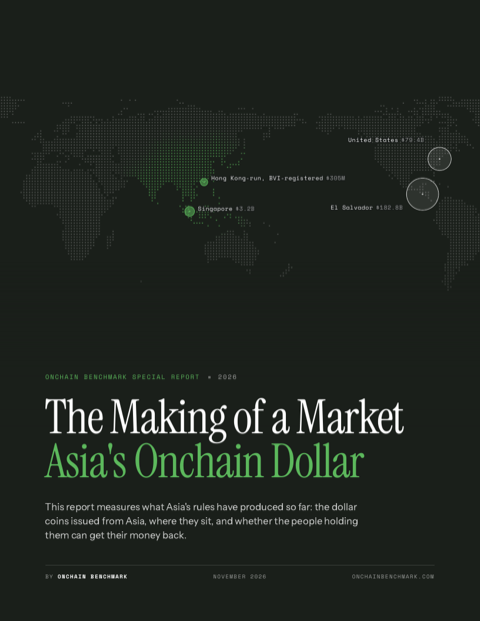
Asia is writing the rules for the onchain dollar. Hong Kong and Japan have stablecoin laws in force; Singapore has published draft legislation, and Taiwan has passed its law. A stablecoin is a digital token built to hold a steady value, usually one US dollar, typically backed by reserves its issuer holds, and it moves on public blockchains around the clock. This report measures what Asia's rules have produced so far: the dollar coins issued from Asia, where they sit, and whether the people holding them can get their money back.
The first finding is scale. Asia's own dollar coins total about USD $3.5 billion, roughly 1.2% of the stablecoin supply OnChain Benchmark measured. The world's largest stablecoin, widely traded across Asia, comes from elsewhere: Tether's USDT, issued from El Salvador, at about USD $183 billion. It is traded from Hong Kong to India, and it makes up 98.5% of the stablecoins on Tron, the blockchain Boston Consulting Group ranks as the busiest for stablecoin payments. OnChain Benchmark found no license or approval for USDT under Hong Kong's, Singapore's or Japan's stablecoin rules. When a region's dollars are issued elsewhere, so are the reserves, the right to cash out and the crisis response.
Asia’s two financial hubs have taken different paths. Singapore licenses issuers of US-dollar coins, which now make up most of Asia’s issued dollar supply. Hong Kong started with coins tied to its own currency and wrote holders’ right to cash out into law.
Why that right matters showed in April 2025, months before Hong Kong’s stablecoin law took effect. Holders rushed to pull their money out of FDUSD, a dollar coin run from Hong Kong but covered by neither city’s stablecoin rules. Its reserves held, but only 16 addresses cashed out directly with the issuer, and redemptions stopped over both weekends on the blockchains that held most of the coin. Hong Kong’s licensed coins must now give every holder a legal right to redeem at par; how fast that right works under stress has not been tested. And neither city’s model yet answers the next problem: a failure that spills across borders.
The verdict: Asia uses the onchain dollar but issues little of it, and none of the dollar coins it does issue gives holders in Asia a statutory right to their money back. Hong Kong has written that right into law, but so far it has licensed only Hong Kong-dollar coins. And OnChain Benchmark found no published agreement among Asian regulators on who acts when a coin fails across borders.
That last gap is the one that matters most. Angelina Kwan, a former senior official at Hong Kong's Securities and Futures Commission, is blunt: "As sure as night [is] day, something is going to happen." Central bankers worry about what they cannot control. "For an Asian central bank, it is a potential leak in the dam," says Duvvuri Subbarao, who governed the Reserve Bank of India through the 2008 financial crisis; the RBI itself opposes privately issued stablecoins. Stablecoins are already here, as Subbarao says. What Asia has not settled is who protects the market when something goes wrong.
Chapter 01 of 05 · Who issues
Asia runs on someone else's dollar
By the numbers
To understand Asia's onchain dollar, start with a coin Asia didn't issue. Tether's USDT, issued from El Salvador, is the world's largest stablecoin and is traded across the region, from Hong Kong to India. Its biggest home is Tron. Tron is a blockchain, not an exchange and not the issuer: Tether issues USDT on many blockchains, and holders choose which one to move it on. Tron became one of the most widely used rails for everyday transfers, and 51% of the USDT OnChain Benchmark measured now sits there.
Tron is the world's busiest network for stablecoin payments by value, according to Boston Consulting Group. It carries USD $94 billion in stablecoins, about a third of the stablecoin supply OnChain Benchmark measured. 98.5% of it is a single token: USDT. Tether says it is licensed as a stablecoin issuer in El Salvador. Hong Kong and Japan have stablecoin laws in force, and Singapore has published draft legislation. OnChain Benchmark found no license or approval for USDT under any of them.
Wayne Huang, co-founder and group chief executive of XREX and co-founder of Unitas Protocol, sees why from inside the trade. XREX moves dollars between Asia's factories and their buyers in Latin America, India and Africa. The factories "absolutely don't want to touch stablecoins," he says. "Doesn't reconcile on their books." Their buyers, short of dollars at home, run on them, and almost always on one coin. "I don't know why these pockets of liquidity exist," Huang says. "But they're just able to source USDT."
Angelina Kwan, a former senior official at Hong Kong's Securities and Futures Commission who went on to serve as chief operating officer of the crypto exchange BitMEX and of HashKey Group, is more direct: "I know that Tether is very much used in Hong Kong."
OnChain Benchmark Asia Dollar Stablecoin Index
Asia's dollars, to scale
Asia issues almost none of it
Of the stablecoin supply OnChain Benchmark measured, most is issued from El Salvador and more than a quarter from the United States. US-dollar coins from Asia-Pacific issuers account for about 1.2%.
Three Asian dollar coins qualify: USDG, from Paxos's Singapore entity; XUSD, from Singapore's StraitsX; and FDUSD, founded and run from Hong Kong. Together they total about USD $3.5 billion. USD1, a single dollar coin launched in 2025 by the US-based World Liberty Financial, is bigger by about USD $0.5 billion on its own.
OnChain Benchmark Asia Dollar Stablecoin Index
Where the world's onchain dollars are issued
It's just like why we're speaking English today. It's not my mother tongue, but to do business, you speak English. Same thing with the US dollar.
Wayne Huang
Co-founder and group chief executive · XREX
Few people have seen the politics of digital dollars from closer range than Dante Disparte. As head of policy and communications at the Libra Association, Facebook's ill-fated bid to build a global digital currency, he watched regulators close ranks against a private money that might rival their own. Today he is chief strategy officer at Circle, issuer of USDC, the regulated dollar stablecoin that went where Libra couldn't. He names the pressure behind Asia's shift: "Asia is not innovating with stablecoins because they want to; they're innovating with stablecoins because they have to."
Why it matters
That is why a report on Asia's onchain dollar starts with a coin from El Salvador. When a region's dollars are issued elsewhere, so are the reserves, the redemption terms and the crisis response. If USDT stumbled, no Asian stablecoin regulator would be the one in charge. Asia has started writing its own rules, and its two financial centers have placed very different bets.
- 1944–1997Act one: the anchor. Asia tied its currencies to the dollar to join the world economy. Hong Kong fixed its dollar at HKD 7.80 in 1983, a link that still holds.
- 1997–2014Act two: the insurance policy. After the Asian financial crisis, the region built vast dollar reserves so it would never again be caught short. Much of that money was lent back to Washington in US Treasury debt. Even so, in 2008 it was the US Federal Reserve that opened emergency dollar lines to Seoul and Singapore.
- 2014–todayAct three: the onchain dollar. Tether launched in 2014, and the onchain dollar spread across Asia, held in coins whose reserves sit with issuers outside the region.
- NextWhat comes next. Asia is now writing its own stablecoin rules, and with them comes a choice it has never had: whether the dollars it uses onchain must be backed by assets bought in Washington.
Chapter 02 of 05 · Singapore and Hong Kong
Two cities, different bets
By the numbers
Asia's two financial centers answered that dependence in different ways. Singapore licensed dollar issuers and let them reach the world. Hong Kong started with its own currency and with the holder's right to get money back. Eighteen months of issuer attestations and onchain data show how each city's coins have fared since.
The reversal
At the end of March 2025, FDUSD, then issued by a Hong Kong company under First Digital, had USD $2.6 billion in circulation across every chain. The two dollar coins issued under Singapore licenses, USDG from Paxos Digital Singapore and XUSD from StraitsX, had USD $220 million between them, according to the issuers' attestations. Today the order has reversed: about USD $3.2 billion for the Singapore-licensed pair and USD $305 million for FDUSD.
OnChain Benchmark Asia Dollar Stablecoin Index
The reversal, on every chain
The flip has two halves. FDUSD shrank by almost 90%, from USD $2.6 billion to USD $305 million. Over the same period, the Singapore-licensed pair grew about fourteenfold, almost all of it USDG. OnChain Benchmark's data shows when each coin grew or shrank, not why each holder came or went.
Two events fall within that period. The first was a run in April 2025, which Chapter 3 examines. The second was Hong Kong's choice of where to begin. When its Stablecoins Ordinance took effect in August 2025, Vincent Chok, First Digital's founder and chief executive, says the regulator made the sequencing plain. "They also said that the US dollar wasn't going to be in their scope anytime soon," he says. "Without a license, you can't issue a stablecoin there, regardless of currency. So that's when we made the move to BVI." In mid-August, First Digital announced that FD121 (BVI) Limited had taken over as FDUSD's issuer. Its custodian, First Digital Trust, stayed in Hong Kong.
Hong Kong's first two licenses went to bank-linked issuers launching Hong Kong-dollar coins, a choice Angelina Kwan, who has sat on both sides of the table, first as a regulator and later as chief operating officer of BitMEX and of HashKey Group, reads as caution by design: "They're going to do it to the two most safe pair of hands that they could possibly think of." The city's own dollar is pegged to the US dollar, so a licensed Hong Kong-dollar coin is close to a dollar coin for many uses, and it can keep the reserves, the redemption and the supervision at home. Chapter 4 looks at what that bet buys holders.
Singapore made the opposite bet: a licensing home for dollar issuers serving a global market. "Singapore is perceived as much more neutral," says Tal Elyashiv, general partner at True Global Ventures and co-founder of the tokenization platform Securitize. "It's Asia, but it doesn't feel like Asia."
What reach built: exchange money
Tether's USDT on Tron carries the most stablecoin payments, and USDT is the coin behind the trade Huang describes. Asia's own dollar coins became something different: coins that live mostly on trading platforms. Singapore's lead is really one coin. USDG is about 90% of Asia's issued dollar supply, and where it lives shows what it is for. US-regulated stablecoins sit mostly on Ethereum, with 5.8% of their measured supply on chains run by exchanges or brokers. Asia's issued dollars are the reverse. 61% sit on exchange- and broker-run chains, mostly OKX's X Layer and Robinhood Chain, and about 17% on Ethereum. USDG is distributed through Paxos's Global Dollar Network, whose partners, including Robinhood and Kraken, receive most of the coin's rewards, according to Paxos.
OnChain Benchmark Asia Dollar Stablecoin Index
Where each region's dollars live
The same pattern runs through every Asian-issued coin. At the October 25 close, at least 65% of FDUSD sat in Binance-tagged wallets, and 87% of its Ethereum supply, against 13% for Circle's USDC on Ethereum. It is not uniquely Asian: USD1, a US coin also sold mainly through exchanges, was 72% Binance-tagged on Ethereum. When an exchange is a coin's main road to market, the coin ends up in that exchange's custody.
OnChain Benchmark Asia Dollar Stablecoin Index
Who holds Asia's dollars
The issuers describe the same road. Every new FDUSD "goes to our clients, which is institutional, whether it be market makers or OTCs," Chok says. "They mint, they put it into the secondary market."
Exchanges want more than a road to market. They want a dollar coin of their own, for a simple reason: the business a coin generates goes to whoever controls it. Binance tried to keep that business at home, and found out how fragile the arrangement could be.
Gin Chao knows that calculus from the inside, and he knows the man who built Binance better than most. Chao and Changpeng Zhao met through mutual friends in China more than a decade ago, both the children of immigrant families in North America, raised by parents steeped in science and scholarship. Their friendship took shape at the poker table, where Zhao was always the first to correct the pot if anyone put in too many chips or too few. For Chao, who had spent years doing business in China, where contract law often fell short, that habit said everything. When a contract can't protect you, you have to trust the person across the table. It is also the problem blockchains set out to solve: how to keep the pot honest when you can't count on everyone at the table. Zhao himself pleaded guilty in 2023 to a US charge of failing to maintain an effective anti-money-laundering program at Binance, and was pardoned in October 2025.
Chao went on to serve as Binance’s head of strategy, running its venture arm and corporate development, and says he also sat on the board of Binance.US. Now founding partner of No Limit Holdings, an early backer of synthetic-dollar issuer Ethena, he puts the exchange logic plainly: “The fee volume that all those transactions generate, they would rather be able to capture in their own chain, their own gas fees, instead of paying somebody else.”
Binance’s answer was Binance USD. To issue it, Binance turned to Paxos, a New York-regulated trust company. In Chao’s view, that was the right partner, because a New York trust license is very difficult to get. That choice also put the coin under a New York regulator. In February 2023, New York’s financial regulator ordered Paxos to stop minting BUSD. It was then the world’s third-largest stablecoin and the dollar behind more than a third of spot trading on Binance, according to The Block. Within days, its supply began to shrink. The coin carried Binance’s name, but the printing press, and the regulator, belonged to someone else.
Chao still sees the commercial case. “I don’t think there’s any particular reason why BUSD should have gone away,” he says. What it showed is who holds the switch: “As long as you’re dealing with a sovereign currency, you are going to be subject to the whims of the regulations.”
A licence alone does not create users. Of the USD $34 million of XUSD in existence at the October 25 close, 94% sat in the wallets that receive new mints or in Binance's. "XUSD is really, really preferred by the regulator and the government," says Wayne Huang, whose company, XREX, holds a Singapore payments license. "The problem we face is, well, none of our customers [are] using XUSD." Chao's rule: "You go where the liquidity is."
USDG by chain, August 7 to the October 25, 2026 close
| Chain | Start (USD) | Latest (USD) |
|---|---|---|
| X Layer | $1,955M | $1,319M |
| Robinhood Chain | $339M | $678M |
| Solana | $651M (August 6) | $623M |
| Ethereum | $464M | $393M |
| Ink | $62M | $65M |
| Arbitrum | $0.6M | $67.4M |
| Mantle | not yet launched | $0.5M |
Some regulators are leaning toward a split, with banks as issuers. Hong Kong's first licenses went to bank-linked issuers, and Taiwan's law requires both central bank consent and FSC approval to issue a stablecoin. Huang, who runs both a payments business and an exchange, agrees. "Exchanges today [are] still one of the best growth engines for stablecoins," he says, "but they shouldn't be the issuer."
Why it matters
Singapore's model delivered reach: Asia's biggest dollar coin, used by traders worldwide. Hong Kong's model is built for protection, and it has not yet been tested at scale. The two bets diverge at the moment that matters most to a holder: when everyone wants their money back at once. In April 2025, an Asian dollar coin built for exchanges faced exactly that.
Chapter 03 of 05 · The April 2025 run
The reserves held. The exit was narrow.
By the numbers
A stablecoin makes one promise: hand it back, get a dollar. "The only good of a stablecoin is how stable is it and how redeemable is it," says Angelina Kwan, a former senior official at Hong Kong's Securities and Futures Commission who now runs the licensing consultancy Stratford Finance.
Singapore's model built coins for exchanges. The April 2025 run on FDUSD, a coin distributed the same way, shows what that design means for a holder at the moment of stress. On reserves, it held up. On the exit, OnChain Benchmark's data shows how narrow the door was.
Two runs, two recoveries
Dante Disparte, chief strategy officer at Circle, which issues USDC, puts the test plainly. "On the US dollar bill, it says 'In God We Trust,'" he says. A stablecoin that hopes to be trusted at the same scale "has to say 'in code we trust,' and the only true time you know that it actually works as advertised is in a period of stress."
The first lesson came from a coin with no cash behind it. In May 2022, TerraUSD, an algorithmic dollar coin backed by a sister token rather than cash, collapsed within days. Tens of billions of dollars vanished, and a bitcoin reserve built to defend the peg was spent trying to hold it.
The next two runs hit coins that did have reserves, and both survived. On Friday, March 10, 2023, California regulators closed Silicon Valley Bank, where Circle held USD $3.3 billion of USDC's roughly USD $40 billion in reserves. USDC fell to about 88 cents on Saturday, March 11, while banks were closed for the weekend. It was back near a dollar by Monday, March 13, after Washington said on Sunday that every SVB depositor would be protected.
FDUSD's test came in April 2025, and here the chain records every step. On April 2, Tron founder Justin Sun posted that First Digital Trust was "effectively insolvent." The claim concerned a different coin, TrueUSD, part of whose reserves the trust held as custodian. First Digital called it "completely false." FDUSD holders ran anyway, and the coin lost its dollar peg.
"If there was a request for redemption, we have to honor that," says Vincent Chok, First Digital's founder and chief executive. Most reserves, he says, sat in Treasury bills. "You have to cash out of those treasuries in time."
OnChain Benchmark Asia Dollar Stablecoin Index
Inside the run
The data shows three things.
The money was there. The issuer burned USD $1.1 billion of FDUSD and minted USD $175 million in the two weeks to April 14, and the coin's total supply fell 35%. At First Digital's March 31 and April 30 attestations, onchain supply matched the attested circulating supply, and reserves exceeded it.
The door was narrow. Just 16 addresses sent FDUSD back to the issuer, and three of them accounted for 80%. Chok says that was by design. "We never sold to retail directly, so it was the institutions that sold," he says. "Any redemption from the retail market came from the institutional side, not from us directly." Gin Chao, who watched exchange queues from inside Binance as its head of strategy, explains who reaches the door first: "Institutions generally algorithmically are first in line and are physically located first in line."
The door closed on weekends. On Friday, April 4, a Hong Kong public holiday, USD $176 million was redeemed. Then, on Saturday and Sunday, no redemptions were processed on Ethereum or BNB Chain. The door reopened at 10:32 on Monday morning, Hong Kong time, USD $201 million was redeemed that day, and it shut again the following weekend. The market never closed; redemptions paused only on days when banks in both Hong Kong and New York were closed.
That is the gap Wayne Huang of XREX warns about. "There is this inherent availability mismatch because banks don't run 24 by seven, but crypto moves 24 by seven," he says. "It's not whether you have the reserve or not. It's all about liquidity." Chok describes the same wall from inside the run: "It's not just like we have the funds in place. We already sent out the request to get redemption out, but the banks are the ones that [say], hey, we need all these."
Geography makes it worse, Huang argues, because "none of these reserves are in Asia." He sketches the scenario. An issuer sells Treasury bills in New York and wires, say, USD $5 billion to Asia, and the correspondent bank in between flags it. "Oh, finally it triggers our AML. We gotta review it," he says. "For 24 hours, 48 hours." By then, "the market just says, 'Oh my God, they don't have the reserves. I can't get my money.'"
The wall is not unique to stablecoins. Franklin Templeton was among the first major asset managers to run a money market fund on a public blockchain, and it now sells tokenized versions in both Hong Kong and Singapore. Those fund tokens can move between wallets at any hour, but cashing out still depends on markets that close. "If you want liquidity on weekends, there's got to be a market maker ready to accept or provide liquidity, and incur a fee for that," says Chetan Karkhanis, who has spent more than a decade at Franklin Templeton and came to digital assets through the firm's Asia ventures arm. Now senior vice president for digital asset partnership engagement, he has been the public face of its recent tokenized-fund distribution deals in Asia, including with HashKey in Hong Kong. "We do think that the technology holds a promise of 24/7 365. However, the actual market making and liquidity behind that has to be there in order to facilitate this."
Who has the right to hand a coin back
What protects a holder is a right to par that holds in law, not a reserve alone. Disparte defines a stablecoin as "a cryptographic token entitling the holder to redemption at par, even in the issuer's bankruptcy," a right that must be "passed through the entire value chain, from issuer to exchange to bank to neo bank to digital wallet." His shorthand: "Issuance is a privilege. Redemption is a right."
Who can redeem at par, and on what basis
| Coin | Issuer's home | Right for holders in Asia | Right in the EU |
|---|---|---|---|
| USDG | Singapore (MAS payments license) | Contract only, through a verified Paxos account | Statutory right at par (MiCA) |
| XUSD | Singapore (MAS payments license) | Contract only, through a verified StraitsX account | n/a |
| FDUSD | British Virgin Islands | Contract only: under First Digital's terms, the issuer redeems only for onboarded clients in supported jurisdictions | n/a |
| Hong Kong-licensed HKD coins | Hong Kong (HKMA license) | Right at par for every holder, within one business day | n/a |
None of the three Asian-issued dollar coins gives holders in Asia a right to redeem at par grounded in law. Where a path exists, it rests on the issuer's terms. Singapore's stablecoin framework, finalized by MAS in 2023 but not yet law, requires issuers to return par value to holders within five business days of a redemption request; Paxos said in 2025 that USDG's Singapore issuance has been substantially compliant with it. Asia's biggest dollar coin does carry a statutory right, but for Europeans. "The holders of USDG residents of the EEA have a right of redemption with Paxos EU at any time and at par value," Paxos says, under the EU's MiCA rules.
Chok rejects the idea that every holder should be able to walk up to the issuer. "I don't think they should put that onus on the actual issuer," he says. Onboarding millions of retail users, with identity checks and anti-money-laundering reviews for each, would be "an administration compliance nightmare." Disparte, whose company also deals primarily with institutions, draws the line differently: holders need not be direct customers, but the right must reach them.
Chao offers the market's view of why exit doors stay narrow. "You want to incentivize deposits and disincentivize withdrawals," he says. "That's a built-in business model for every financial institution, frankly."
Why it matters
Both runs ended well. The reserves were real, and the institutions at the front of the line could redeem. The holders further back, mostly on exchanges, could choose to wait or sell at a loss.
Today, whether an ordinary holder can get a dollar back depends on each issuer's own rules, which the issuer writes and can change. That matters more as stablecoins grow: a run on one coin can spread to others, and more ordinary people get caught in the line. Hong Kong is betting that the right to a dollar back should be guaranteed by law, not left to the issuer.
Yes, in 2021, I wrote in an opinion piece that the United States might see dollar stablecoins not as something to regulate away but as a way to extend the reach of the dollar. It was not a widely held view then. But Washington has since done more or less exactly that. The GENIUS Act regulates dollar stablecoins, yes, but it also blesses them. For America, every stablecoin is a new buyer of Treasury bills. For an Asian central bank, it is a potential leak in the dam.
I thought the challenge would come from Big Tech. Facebook's Libra was the spectre then. Libra died; the threat did not. It simply came through quieter doors: exchanges, remittance apps, peer-to-peer desks.
So the question for Asia is no longer whether stablecoins will come. They are here. The question is whether we build our own digital rails fast enough that our people don't need to borrow someone else's. That is the real case for a central bank digital currency: not as a trophy, but as a defence.
My advice for Asian central banks five years ago was festina lente: make haste slowly. That advice still holds. I would only put a little more weight on the haste.
Duvvuri Subbarao
Governor of the Reserve Bank of India, 2008–13
Chapter 04 of 05 · Hong Kong
Hong Kong writes the exit into law
By the numbers
This is what Hong Kong's bet buys. It has set a bar that none of the three Asian-issued dollar coins meets. Under the HKMA's Guideline on Supervision of Licensed Stablecoin Issuers, a licensee must give every holder, not only its direct customers, a right to redeem at par. If the issuer becomes insolvent, holders can still direct the sale of the reserves to be repaid pro rata, and claim against the issuer for any shortfall. Valid requests "should be processed within one (1) business day" unless the HKMA approves otherwise, with no unreasonable fees or unduly burdensome conditions. Where applicable, holders must first pass customer due diligence.
Four rulebooks, one question: can a holder get a dollar back?
| Hong Kong | Singapore | EU | United States | |
|---|---|---|---|---|
| Law in force | Stablecoins Ordinance, Aug 2025 | Payments license; stablecoin amendments proposed September 2026, not yet law | MiCA | GENIUS Act, signed July 18, 2025; takes effect January 18, 2027 |
| Par right for every holder | Yes, in the Ordinance | By contract today | Yes, statutory | Not a stated holder right in the Act; issuers must redeem at a fixed value. From January 2027, OCC-supervised issuers must redeem for customers who pass onboarding |
| Deadline | 1 business day, in the HKMA guideline | Set by issuer; five business days under MAS's framework once it becomes law | "At any time" | None in the Act; two business days for OCC-supervised issuers from January 2027 |
| Survives issuer insolvency | Yes, through a claim on the reserves | By contract | Partly: e-money institutions must ring-fence or insure holders' funds | Holders have first claim on the required reserves |
| Who may issue | Licensed; first two bank-linked | Licensed payments institutions | Authorized e-money institutions and banks | Licensed issuers |
The HKMA licensed two issuers in its first round, HSBC and Anchorpoint, a venture led by Standard Chartered with HKT and Animoca Brands. Both are bank-linked. Angelina Kwan, the former Securities and Futures Commission official who called the pair "the two most safe pair of hands," adds that "they were backed by banks that gave a further control." Dante Disparte of Circle calls the model "bank first, but not bank only."
The logic is the backstop. If a bank-linked issuer suffers a run, says Wayne Huang of XREX, "at least banks have some systemic defense, meaning that the regulator and the government can try to bail out the banks. Exchanges, currently nobody can bail you out."
Tal Elyashiv of True Global Ventures, who has spent a decade building tokenized markets, sees more than an early lead. "It's not a head start; it's a working system," he says.
Can a one-day clock hold?
The April 2025 run is the test case. On both weekends, FDUSD's redemptions on its two main chains stopped entirely, while the banks behind them were closed. Hong Kong's "one business day" is measured in banking days, which is a realistic standard. But a run does not keep business hours, and Vincent Chok of First Digital points out that no issuer controls the banks' compliance timeline. The HKMA has left itself room: the clock applies "unless otherwise approved," and the guideline "will be kept under review." How fast the right works in practice is still untested. Neither licensee has published redemption times. HSBC's RedCoin reached retail users through PayMe on October 23; Anchorpoint's HKDAP is still open only to institutions and professional investors.
Why Hong Kong dollars
Both licensed issuers chose to launch Hong Kong dollar coins, not US dollar coins. That stands out, because the one Asian local-currency coin OnChain Benchmark measured at this close is small: Singapore’s XSGD is worth about USD $15 million on the chains OnChain Benchmark measures. Dollar stablecoins issued in Asia total about USD $3.5 billion, more than 200 times as much. (Japan’s JPYC and Indonesia’s IDRX were not measured at this close.)
There’s a structural reason local-currency coins struggle. A stablecoin has to hold its reserves in safe, short-term assets it can sell quickly, and nothing rivals the US Treasury bill market for that. Hong Kong is better placed than most. Its currency is pegged to the US dollar, its interest rates move with US rates, and it has one of the region’s deeper markets for short-term government bills. That puts Hong Kong in an unusual position: the US dollar anchors its value without having to be the asset underneath. An HKD coin carries the dollar’s stability through the peg, but because it is a local currency, Hong Kong could in time back it with a different mix of reserves, since the HKMA, not Washington, decides what counts as an eligible HKD reserve asset.
Same language, different reserves
The dollar is Asia's common language of trade, as Huang says. But a stablecoin has two parts: the currency it is priced in and the assets that back it. They no longer have to come from the same place.
Today's dollar coins are backed largely by US Treasury bills and bank deposits. "For America, every stablecoin is a new buyer of Treasury bills," as Duvvuri Subbarao, former governor of the Reserve Bank of India, puts it. A Hong Kong-dollar coin can break that link. The HKMA's guideline requires reserves in the coin's own currency unless the HKMA approves otherwise. Because the Hong Kong dollar is pegged to the US dollar, a holder gets something that behaves much like a dollar, while the reserves can stay at home.
The rule has an exception. An issuer may hold reserves in another currency with the HKMA's written approval. Neither licensee has said whether it will use that exception. The choice decides whether Hong Kong's coins become new buyers of Treasury bills or of Hong Kong's own Exchange Fund paper. It also decides where an issuer sells assets during a run: in Hong Kong, on Hong Kong banking days, or in New York, across the correspondent bank Huang warned about in Chapter 3.
Even fully local reserves would not leave the dollar behind. Hong Kong's peg is itself backed by US-dollar assets. What changes is who holds the reserves, where, and under whose supervision. Now an Asian financial center can use the dollar as its language without its reserves leaving the region. Whether Hong Kong, and those who follow it, choose to is the political story to watch.
Washington is pulling the other way. Under the GENIUS Act, a foreign issuer that wants to sell to Americans under its home licence must, among other conditions, hold enough reserves at US financial institutions to meet its American customers' liquidity demands, unless a US reciprocal arrangement provides otherwise. If you want to sell to Americans, you have to keep dollars in America.
Power over money has never come only from holding it. Economists call this the dominant-currency paradigm: the currency that trade is priced and settled in shapes prices, monetary policy and influence. Onchain, there is a new layer: who runs the chains, issues the coins and supervises the reserves. The contest is moving onchain, and the advantage will go to those who build the rails.
A coin for a trading city
The use case, Kwan argues, is convenience in a trading city. "People will start [to] be thinking about convenience," she says. "Hong Kong does so much trade." HSBC launched RedCoin on October 23 through PayMe, its payments app, with wallets rolling out to PayMe's 3.3 million users over the following days. Users can send money to friends and pay at more than 100,000 shops and businesses, and HSBC's Hong Kong banking app follows later this year. The question is whether people will bother. Hong Kong already pays for its coffee, groceries and MTR rides with Octopus cards and mobile wallets that work fine. RedCoin has to offer something those don't. Anchorpoint's HKDAP, the other licensed coin, has taken a different route: it has been open only to institutions and professional investors, in a test phase, since August 12.
RedCoin runs on HSBC's own private blockchain, not a public one: "We utilise our private blockchain for HSBC RedCoin production and distribution," the bank told OnChain Benchmark. Think of it as the difference between a public ledger anyone can read and a bank's internal books. Coins on public blockchains can be counted by anyone, and OnChain Benchmark counts them on every public chain it reads. RedCoin can't be checked that way. Anyone who wants to know how many coins exist, and what backs them, has to rely on what HSBC publishes.
HSBC says it will publish those numbers daily, along with weekly statements and regular checks by an outside auditor confirming what the reserves are worth and what they consist of. On October 25, its site showed HKD 80.8 million (about USD $10 million) of RedCoin in circulation, backed by HKD 81.8 million in reserves, all of it reported as cash. Those reserves are kept separate from the bank's own money, inside HSBC; the RedCoin white paper names HSBC as custodian of the reserves and an HSBC trust company as their trustee. Asked about the reserves, the bank said only that a separate unit, HSBC Digital Assets Custody, "provides safekeeping services for HSBC RedCoin." HSBC declined to say how it will manage the reserves over time. "We do not share details of reserve management for our products," the bank said.
Everyday users come first; big business comes later. HSBC says it plans to expand RedCoin to corporate and institutional clients "in line with Hong Kong's evolving digital asset and currency landscape," but gave no timeline. It calls RedCoin "a new payment type that will complement our existing offers." For large clients, those offers already include its Tokenised Deposit Service, a digital version of ordinary bank deposits used for business payments. Later this year, HSBC says, customers will also be able to use RedCoin to invest, including a tokenized share class of its Hong Kong-dollar money market fund.
Whether RedCoin becomes part of everyday life in Hong Kong or stays a bank’s experiment, the answer will show up in the numbers HSBC has promised to publish every day.
Why it matters
Hong Kong has written the holder's exit into law, but so far only Hong Kong-dollar coins are licensed under it, and only inside Hong Kong. The dollar coins Asia actually uses sit under other rules, or none. And a run would not stop at the border.
Chapter 05 of 05 · Contagion
The run nobody has planned for
By the numbers
Reach and protection are both national answers. Asia licenses stablecoins one jurisdiction at a time, and a run would cross every border at once.
Angelina Kwan, a former senior official at Hong Kong's Securities and Futures Commission who has sat on both sides of Asia's financial rulebook, runs through the map. Japan has had a regime since 2023, and its first yen-coin issuer began issuing in October 2025. Hong Kong licensed its first issuers in April 2026. Taiwan's legislature passed its law in June; the Executive Yuan has yet to set an effective date. Singapore published draft legislation in September. Strong rules at home, she says, do not cover a crisis that starts elsewhere. "None of the regulators have been working together to start a dialog of what happens if stablecoins that form the basis of products, what if one goes kaput? What if one goes bankrupt?"
She makes it concrete. "Does the Thai central bank know exactly what's happening with products that are issued in Thailand with the basis of a European bank stablecoin, and if that European bank stablecoin went belly up, who are they going to contact?" Europe, at least, has a forum, she says. "At least in Europe, they talk, but what about Asia?"
Some cooperation is under way, on settlement rather than on failure. On October 2, Hong Kong's and Malaysia's central banks agreed to set up a joint workstream on cross-border stablecoin use. On October 23, the Monetary Authority of Singapore said Bank Negara Malaysia and the Bank of Thailand had joined BLOOM, its initiative on cross-border settlement in tokenized deposits and regulated stablecoins. Neither sets out who acts when a coin fails.
The contagion would be fast. "If one has a run, then everybody will look at this and go, 'Oh my God… let me get out of it right now,'" she says. "Dump, dump, dump, dump, dump."
The biggest exposure sits outside Asia's main stablecoin regimes. Tron runs 98.5% on USDT, a coin issued from El Salvador, for which OnChain Benchmark found no license or approval under Hong Kong's, Singapore's or Japan's stablecoin rules.
Dante Disparte of Circle sees the answer differently: not more local rules, but rules that connect. "Regulators [should] resist the urge to balkanize the activity and the liquidity, because fungibility is in fact the best feature of these products," he says. Stablecoins, in his phrase, "are launched locally, they are experienced globally, but they die locally. And so, what you ultimately want is airports, not sandboxes." Tal Elyashiv of True Global Ventures is more patient: cross-border regulations "take a long time to get resolved."
The United States has already built a version of that airport, on its own terms. The GENIUS Act works like an international driver's licence. Pass your test at home, and if Washington agrees your test is as tough as its own, you can drive in the United States. Under Section 18 of the act, the US Treasury Secretary can rule that another jurisdiction's stablecoin rules are comparable to America's. A dollar coin licensed there, in Singapore or Hong Kong for example, could then be offered to Americans under its home licence. Visitors still follow local rules of the road: the issuer must register with the Office of the Comptroller of the Currency and hold enough reserves at US financial institutions to meet its American customers' liquidity demands, unless a reciprocal arrangement with the United States says otherwise. The act takes effect on January 18, 2027. As of October 25, 2026, no comparability ruling had been published in the Federal Register.
The door swings both ways, says Disparte: if a Japanese yen stablecoin existed, "should people be able to use it in the United States and carry it into the stream of commerce? The answer should be yes." Such a provision, he says, is "very rare," and "it was Circle that championed that concept."
It is also an exercise of power. Washington writes the test and decides who passes, and every coin it admits must, unless a reciprocal deal says otherwise, hold reserves at US financial institutions for its American customers. Asia can write its own rules. The road into the world's largest market still runs through Washington's.
Kwan's prescription is specific. "If ASEAN works together [on] reciprocity and working together on contingency measures and being able to be interoperable and work as a block, that will be the most positive for Asia." Her warning is blunter. "As sure as night [is] day, something is going to happen. And if they don't start now to work on contingency measures, and work on who's going to step in, who's going to make what reports, who's going to talk to the public to calm people…"
Five markers to watch
Five markers, today's baseline
| Marker | Question | Today's baseline |
|---|---|---|
| Supply | Do Asian-issued dollar coins grow faster than the market? | Asia-Pacific dollar coins: 1.2% of measured stablecoin supply |
| Rights | Does any give holders in Asia a statutory right to par? | 0 of 3 |
| Hong Kong's dollar | Do the licensed HKD coins reach the public and grow? | RedCoin: HKD 80.8 million in circulation (HSBC, October 25), retail since October 23. HKDAP: HKD 6.1 million (Anchorpoint, October 21), institutions and professional investors only |
| Reserves | Do Asia's licensed coins keep their reserves at home? | HSBC reports RedCoin's reserves as cash, held in segregated accounts within HSBC, and does not share further details; Anchorpoint reports bank deposits and debt securities. Neither has said whether it will use the HKMA's exception to hold reserves in another currency |
| Coordination | Do Asian regulators agree who calls whom? | No published failure arrangement found. On October 2, Hong Kong's and Malaysia's central banks agreed to set up a joint workstream on cross-border stablecoin use; on October 23, Malaysia's and Thailand's central banks joined Singapore's BLOOM settlement initiative |
The close
Wayne Huang's family carried a book of promises out of Guangdong. The paper survived the war. The promises did not.
Today the same promise fits in a passphrase, and that is real progress. It travels with the holder, and anyone can count how many have been written. But a ledger can only record a promise. It cannot keep one. That still depends on who stands behind the coin, who may redeem it, on which days, and under whose law. When what was then the largest dollar coin issued from Asia faced a run, only 16 addresses cashed out directly with the issuer, and none on a weekend on the two chains that held almost all of it. The coin traded around the clock. The banks behind it kept office hours.
Asia has learned to carry the onchain dollar. It has not yet secured the right to collect it.
The onchain dollar is the first asset to make the journey. Bonds, funds, property and gold are following. The numbers are still small. By the estimate of Chetan Karkhanis, senior vice president for digital asset partnership engagement at Franklin Templeton, tokenized cash funds hold about USD $15–16 billion, against USD $13–14 trillion in traditional ones. But he has watched the crowd change. A few years ago, crypto conferences were "crypto bro-ish," he says, heavy on NFTs and gaming and light on "the gray suits and the black shoes." Not anymore. "Every conference you go to, the banks are showing up, the asset managers are showing up."
Every voice in these pages is betting on that future, or watching it closely.
If Asia gets the dollar right, it will be ready for everything that comes after it.